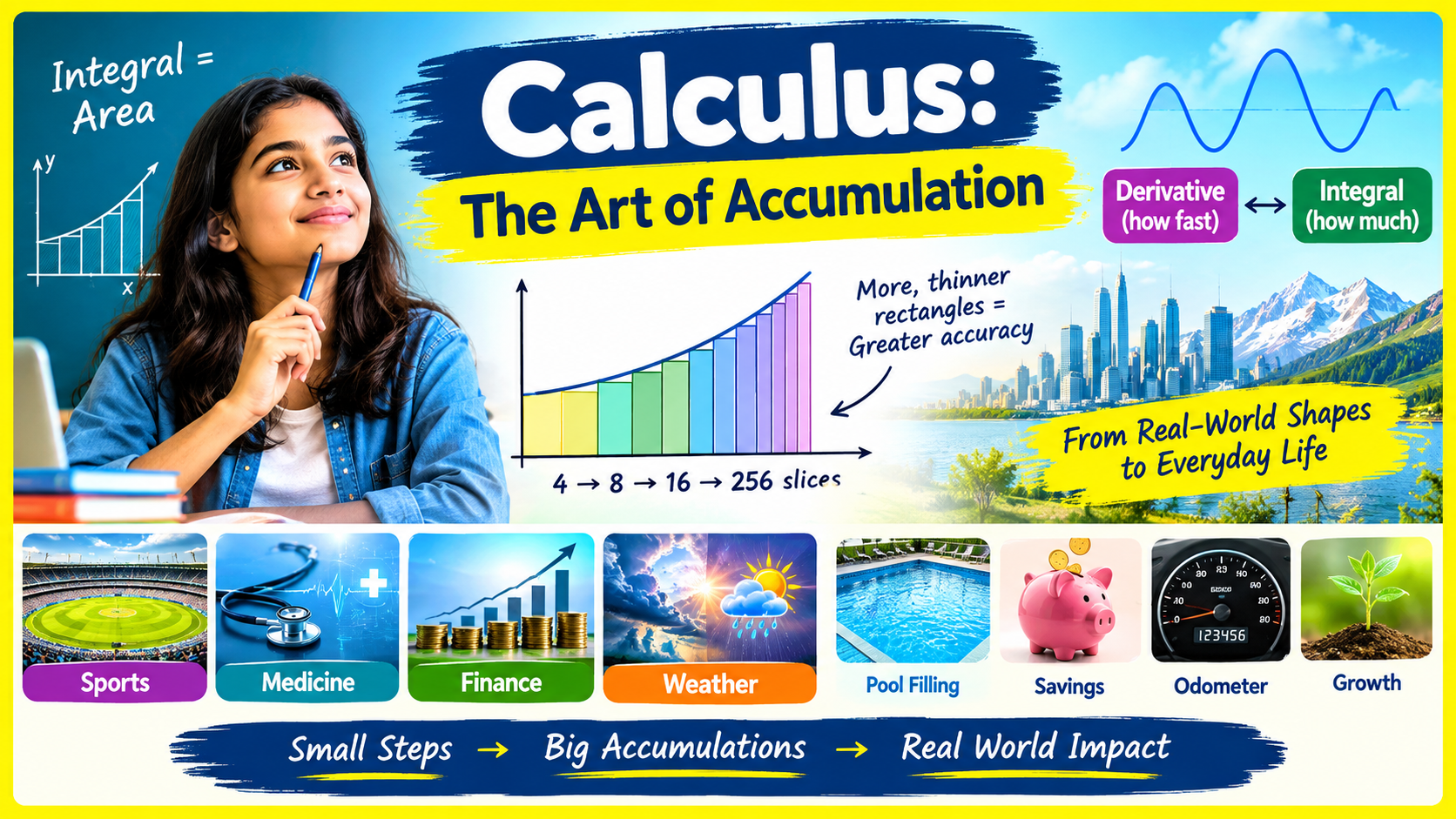
Calculus: The Math of Motion
Students aged 13–16, exam aspirants, and educators introducing calculus benefit from clear, visual methods that make abstract concepts accessible.
 Taught byM Sanjeeva ReddyM.Sc. Mathematics
What you'll learn
Students will master motion by contrasting instantaneous speed and average speed with a car dashboard analogy, drawing tangent lines accurately, and calculating speed from position‑time graphs. They will also distinguish tangent from secant lines, identify the fastest roller‑coaster point by the steepest slope, and correctly order parabola tangents from steepest to gentlest.
Course content
2 modules10 lessons2h 58m
THE SPEEDOMETER SECRET5 lessons · 1h 33m
- The Car That Knew Its Speed
- 01Calculus video 1
- From Average to Instant
- 02Calculus video 2
- The Shrinking Time Gap
- 03Calculus video 3
- Slope Meets Speed
- 04Calculus video 4
- AI's Learning Speedometer
- 05Calculus video 5
SLOPE STORIES5 lessons · 1h 25m
- Slope Detectives - Finding Steepness Everywhere
- 06Calculus video 6
- The Shrinking Gap - Visualising Tangent Lines
- 07Calculus video 7
- Tangent vs Secant - One Point Makes All the Difference
- 08Calculus video 8
- Slope Stories & Playground Connections
- 09Calculus video 9
- Roller Coaster Drops - Feeling the Slope Change
- 10Calculus video 10
About this course
Course Outcomes:
- Distinguish between tangent and secant lines with 100% visual identification accuracy
- Learn the difference between average speed (journey summary) and instantaneous speed (moment reading)
- Learn how car speedometers display instantaneous speed using wheel rotation sensors
- Know that tangent slopes represent instantaneous rate of change on position-time graphs
- Feel curious to explore more mathematics concepts in everyday phenomena
Your teacher

M Sanjeeva Reddy
M.Sc. MathematicsFuture-ready mathematics innovator, blending AI, machine learning, and timeless principles to make math accessible and empowering.