The p-Block Elements — Chemistry of Life, Atmosphere, and Industry Part1
P-block chemistry, simplified — for Class 11-12 learners, NEET and JEE aspirants, and curious beginners alike.
 Taught bySakshi ChauhanB.Sc. Biochemistry, M.Sc. Chemistry, B.Ed.
What you'll learn
Explore the p-block elements, where boron's small-size quirks give way to the inert pair effect and rising metallic character. See how hydrides, oxides, allotropes, and the nitrogen cycle reveal real-world reactivity and industrial importance.
Course content
10 modules10 lessons1h 51m
Introduction to p-Block & Periodic Trends1 lesson · 14 min
- 01P Block Video 1
Group 13: Physical and chemical properties1 lesson · 12 min
- 02P Block Video 2
Boron Compounds1 lesson · 12 min
- 03P Block Video 3
Aluminum Compounds & Industrial uses1 lesson · 13 min
- 04P Block Video 4
Selenium &tellurium-transition from non- metals to metals1 lesson · 10 min
- 05P Block Video 5
Group 14:Carbon allotropes& Chemical behavior1 lesson · 10 min
- 06P Block Video 6
Carbon compounds: CO.CO2, CARBONATES & BICARBONATES1 lesson · 10 min
- 07P Block Video 7
Group 14-silicon & silicates1 lesson · 10 min
- 08P Block Video 8
Group 14-Germanium, TIN &LEAD1 lesson · 10 min
- 09P Block Video 9
GROUP 15-INTRODUCTION.AND PERIODIC TRENDS (NITROGEN FAMILY)1 lesson · 11 min
- 10P Block Video 10
About this course
Course Outcomes:
- Explore, analyse, and predict the chemical behaviour of p-block elements using periodic trends.
- Learn how valence electrons, oxidation states, bonding, and inert pair effect control reactivity and applications
- Inspired by how p-block elements govern life, environment, and modern materials
Your teacher

Sakshi Chauhan
B.Sc. Biochemistry, M.Sc. Chemistry, B.Ed.Chemistry educator known for interactive real-life-based lessons that inspire curiosity and connect with learners worldwide.
More to learn
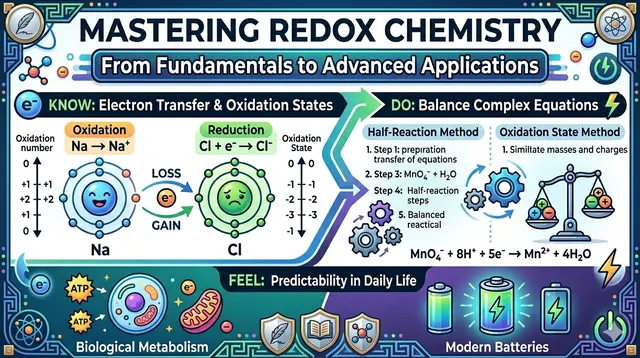
Mastering Redox Chemistry: From Fundamental Transfers to Advanced Applications
Sakshi Chauhan
₹499
View course
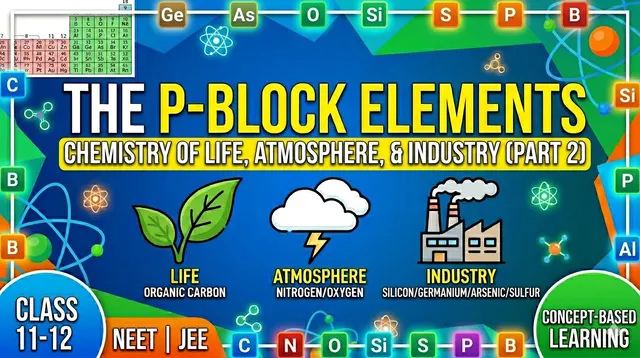
The p-Block Elements — Chemistry of Life, Atmosphere, and Industry-part 2
Sakshi Chauhan
₹499
View course
The D-Block Elements — Chemistry of Transition and Inner Transition Metals Part 2
Sakshi Chauhan
₹499
View course